Selimiye Mosque Features (Selimiye Camii Ozellikleri)
Selimiye Mosque is not merely a building — it is a symphony of architectural elements working together to create one of the most awe-inspiring interior spaces ever constructed. Every feature, from the massive dome to the smallest tile pattern, was designed by Mimar Sinan with deliberate purpose.
This guide walks you through the key features you should not miss during your visit.

The Dome — Sinan's Crowning Achievement
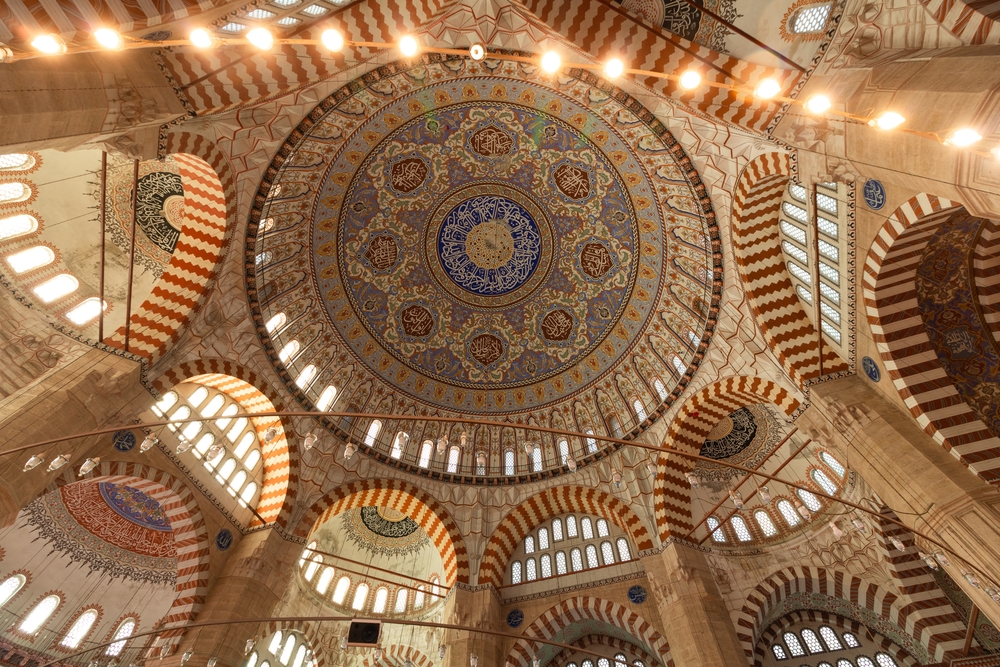
The dome of Selimiye Mosque is the building's most remarkable feature and the element that Mimar Sinan himself considered his greatest engineering accomplishment.
By the Numbers
| Measurement | Value |
|---|---|
| Diameter | 31.3 meters (102.7 feet) |
| Height from floor | 43.3 meters (142 feet) |
| Comparison | Larger than Hagia Sophia (31.2m) |
| Support | 8 pillars in octagonal arrangement |
| Weight distribution | Via muqarnas-filled squinches |
What Makes It Special
The dome appears to float above the prayer hall without visible support — an illusion that Sinan achieved through careful engineering. Unlike Hagia Sophia, which requires massive buttresses and cascading half-domes, Selimiye's dome rests on an octagonal system of eight relatively slender pillars. The transition from the octagonal base to the circular dome is accomplished through muqarnas (stalactite-like decorative squinches) that both disguise the structural elements and add ornamental beauty.
When you stand beneath the dome and look up, the effect is one of infinite space. The dome seems to expand beyond its physical boundaries, drawing your eye upward toward the central medallion of calligraphy.
The Inverted Tulip
At the very apex of the dome, look for a small circle of Iznik tiles depicting an inverted tulip. This enigmatic motif has fascinated scholars for centuries. The tulip was the symbol of Ottoman imperial power, and its inversion is interpreted as an expression of humility before God — even the sultan's power is turned upside down in the house of worship.
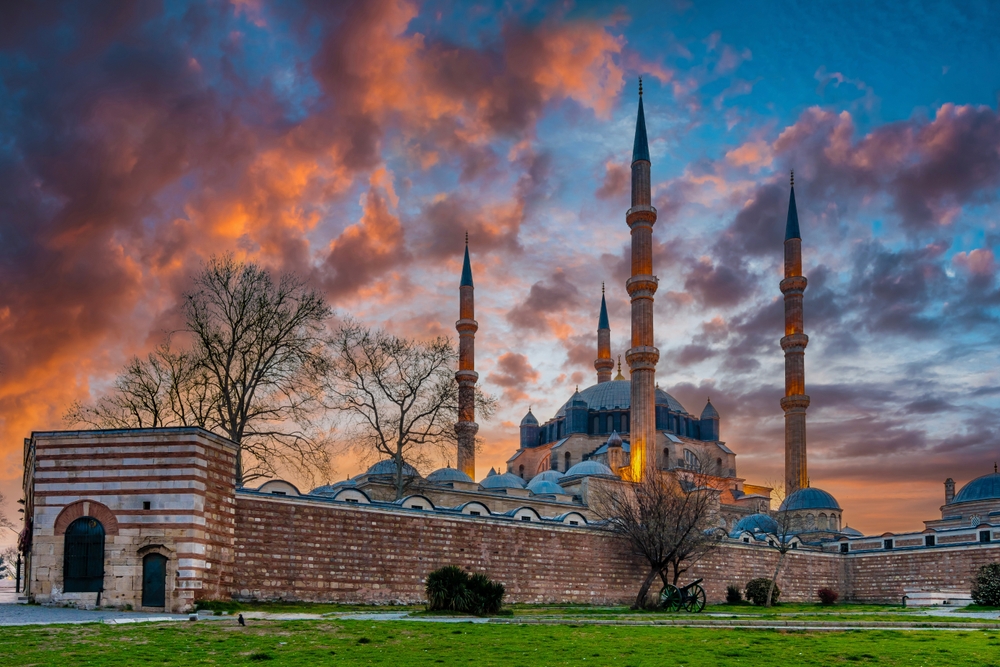
The Four Minarets
Selimiye Mosque's four minarets are among the most remarkable in the world.
Key Facts
- Height: 83 meters (272 feet) each
- Balconies: 3 on each minaret (12 total)
- Internal staircases: 3 separate staircases in each minaret
- Design: Fluted octagonal shafts tapering to pointed caps
Three Staircases in Each
One of the most ingenious features is that each minaret contains three separate, intertwining staircases that allow three muezzins to ascend simultaneously to the three different balconies without ever meeting each other. This was an unprecedented engineering achievement in the 16th century.
Why Four Minarets?
Four minarets was traditionally reserved for mosques commissioned by sultans. Their placement at the four corners of the central building creates perfect visual balance with the dome, giving Selimiye its iconic silhouette that defines the Edirne skyline.
The 999 Windows
The 999 windows of Selimiye Mosque are not merely decorative — they are a fundamental element of Sinan's design philosophy.
Light as Architecture
Sinan conceived of light as a building material. The windows are arranged in tiers of decreasing size:
- Lower tier: Large arched windows at ground level provide warm, direct light
- Middle tier: Medium windows in the walls create depth and shadow
- Upper tier: Small windows in the dome drum create a luminous crown of light
- Dome windows: Tiny openings at the base of the dome produce a halo effect
The result is an interior that changes character throughout the day. Morning light enters from the east, creating long shafts of gold across the carpet. Midday light is diffused and even. Afternoon light from the west brings warm tones that make the tilework glow.
Original Stained Glass
Originally, many of the windows contained colored stained glass (revzen) created by master craftsmen. While most have been replaced with clear glass over the centuries, a few original panels survive, particularly in the qibla wall (the wall facing Mecca).
Iznik Tilework
The tilework inside Selimiye represents the absolute peak of Iznik ceramic art — the 16th century, before the decline that would see the Iznik workshops close by the 18th century.
The Mihrab Wall
The most concentrated display of tilework surrounds the mihrab (prayer niche). Here you will find panels featuring:
- Floral motifs: Tulips, carnations, roses, and hyacinths in brilliant cobalt blue, turquoise, and white
- The famous "Iznik red": A distinctive raised red pigment achieved through a technique involving Armenian bole clay, which was later lost and never successfully replicated
- Geometric patterns: Intricate interlocking designs that demonstrate the mathematical sophistication of Ottoman decorative arts
- Calligraphic panels: Quranic verses rendered in flowing thuluth script
The Sultan's Loge Tiles
The sultan's loge (hunkar mahfili), located in the southeast corner of the mosque, features some of the finest tilework in the entire building. The panels here include rare color combinations and motifs not found elsewhere.
The Muezzin's Loge
Uniquely, Selimiye features a muezzin's platform positioned directly beneath the center of the dome — an unusual placement that allows the muezzin's voice to resonate throughout the entire space.
The Mihrab
The mihrab (the niche in the qibla wall indicating the direction of Mecca) is a masterpiece of marble carving surrounded by Iznik tiles. Its shallow recess is framed by carved marble columns and muqarnas (stalactite vaulting), creating a focal point that draws the eye of every worshipper in the vast prayer hall.
The Minbar
The minbar (pulpit) is carved from white marble and features intricate geometric and floral patterns. Its tall, narrow form with a pointed canopy is a classic example of Ottoman mosque furniture. The marble was quarried from the island of Marmara and carved by master stonemasons.
Note the muqarnas decoration beneath the canopy and the geometric star patterns on the side panels — these demonstrate the high level of mathematical precision achieved by Ottoman craftsmen.
The Sultan's Loge (Hunkar Mahfili)
Located in the southeast corner, elevated above the main floor, the sultan's loge is where Sultan Selim II and subsequent sultans would pray when visiting the mosque. It features:
- Its own entrance from outside (so the sultan could arrive privately)
- Exquisite Iznik tilework surpassing even the mihrab area
- Carved marble railings
- A small room behind for the sultan's rest
- Views across the entire prayer hall
The Courtyard (Avlu)
Before entering the mosque, visitors pass through a spacious rectangular courtyard surrounded by a domed arcade.
Key Elements
- Sadirvan: The central ablution fountain, a beautiful octagonal structure with carved marble
- Domed arcade: 18 small domes supported by marble and granite columns, many recycled from ancient Roman and Byzantine buildings
- Portal: The entrance portal from the courtyard into the mosque is framed with muqarnas and calligraphic inscriptions
- Last congregation area: The arcade served as overflow prayer space during crowded services
The Kulliye (Complex)
Selimiye was not built as a standalone mosque but as the centerpiece of a kulliye — an integrated social complex that served the community. The surrounding buildings include:
Dar-ul Hadith (School of Prophetic Traditions)
Now housing the Museum of Turkish and Islamic Arts, this madrasa features a central courtyard surrounded by student cells and a main lecture hall.
Arasta (Covered Bazaar)
The covered bazaar to the south of the mosque was built to generate income for the maintenance of the complex. Today, it still functions as a shopping street, selling traditional crafts, souvenirs, and Edirne's famous soaps.
Other Buildings
- A primary school (sibyan mektebi)
- A timekeeping room (muvakkithane)
- A library
Tips for Appreciating the Architecture
- Take your time. Spend at least 30 minutes inside to allow your eyes to adjust and notice the subtleties of light and decoration.
- Look up. The dome, pendentives, and upper windows are the most remarkable features.
- Visit the mihrab area. The tilework here is worth close examination.
- Walk the courtyard. Study the column capitals — many are ancient Roman and Byzantine spoils.
- Step outside and look back. The exterior proportions — the perfect balance of dome and minarets — are best appreciated from a distance.