The Story of Selimiye Mosque (Selimiye Camii Hikayesi)
The history of Selimiye Mosque is inseparable from the story of one man's lifelong pursuit of architectural perfection. When Mimar Sinan laid the foundations for Selimiye in 1568, he was already approaching eighty years of age and had designed hundreds of buildings across the Ottoman Empire. Yet he understood that this commission — from Sultan Selim II, in the former Ottoman capital of Edirne — would be his final opportunity to surpass the achievement that had haunted architects for a millennium: the dome of Hagia Sophia.

Mimar Sinan: The Architect Behind the Masterpiece
Early Life and Training
Mimar Sinan was born around 1489 in the village of Agirnas near Kayseri in central Anatolia. Born to a Christian family (likely Armenian or Greek), he was recruited into Ottoman service through the devshirme system — the practice of selecting promising young boys from non-Muslim communities for education and service to the state.
Sinan was enrolled in the Janissary corps, where he received training in mathematics, engineering, and military construction. His talents quickly became apparent during military campaigns, where he designed bridges, fortifications, and supply infrastructure that proved crucial to Ottoman military success.
Rise to Chief Architect
In 1538, Sultan Suleiman the Magnificent appointed Sinan as the Mimarbaşı (Chief Architect) of the Ottoman Empire — a position he would hold for an extraordinary 50 years under three successive sultans: Suleiman I, Selim II, and Murad III.
During his tenure, Sinan was responsible for the design, construction, and maintenance of all imperial buildings. His workshop produced over 370 structures, including:
- 94 mosques (large congregational mosques)
- 52 smaller mosques (mescids)
- 57 madrasas (theological schools)
- 22 mausoleums
- 17 public kitchens (imarets)
- 11 bridges
- 7 aqueducts
- Numerous baths, hospitals, palaces, and other structures
The Three Masterworks
Sinan himself classified his three greatest mosques as representing the stages of his mastery:
-
Sehzade Mosque, Istanbul (1543–1548): His ciraklik eseri (apprentice work). Built to honor Prince Mehmed, Sultan Suleiman's deceased son, this was Sinan's first imperial commission and established his reputation.
-
Suleymaniye Mosque, Istanbul (1550–1557): His kalfalik eseri (journeyman work). The massive complex for Sultan Suleiman showed Sinan's growing mastery of space and engineering, though he was not yet satisfied with his dome solution.
-
Selimiye Mosque, Edirne (1568–1575): His ustalik eseri (masterwork). Here, at last, Sinan achieved the dome he had been pursuing — a single, vast hemisphere that surpassed Hagia Sophia and appeared to float above the prayer hall.
The Commission: Sultan Selim II's Vision
Why Edirne?
In 1568, Sultan Selim II commissioned Sinan to build a grand imperial mosque in Edirne. The choice of location was significant for several reasons:
- Imperial legacy: Edirne had served as the Ottoman capital from 1369 to 1453, and remained an important royal residence. Selim II spent considerable time there.
- Strategic location: Situated near the Bulgarian and Greek borders, Edirne was a critical military staging point and symbol of Ottoman power in Europe.
- The perfect hilltop: The site offered an elevated position where the mosque would dominate the entire city — precisely the kind of dramatic setting Sinan needed for his ultimate architectural statement.
The Scale of Ambition
The commission was not merely for a mosque, but for an entire kulliye (social complex) that would include:
- The central mosque
- A madrasa (school)
- A dar-ul hadith (school of prophetic traditions)
- An arasta (covered bazaar) generating income for the complex
- A library
- A timekeeper's room
This integrated design reflected the Ottoman concept of the mosque as the center of community life — a place for worship, education, commerce, and social services.
Construction (1568–1575)
Engineering Challenges
The construction of Selimiye presented extraordinary engineering challenges that Sinan addressed with innovative solutions developed over decades of practice:
The Foundation: The hilltop site required extensive ground preparation. Sinan's engineers leveled the terrain and laid massive foundations capable of supporting the enormous weight of the dome structure.
The Dome: At 31.3 meters (102.7 feet) in diameter, the dome was Sinan's answer to the 31.2-meter dome of Hagia Sophia. But where Hagia Sophia required enormous buttresses and half-domes to support its weight, Sinan devised an octagonal support system using eight pillars that distributed the load more efficiently and elegantly.
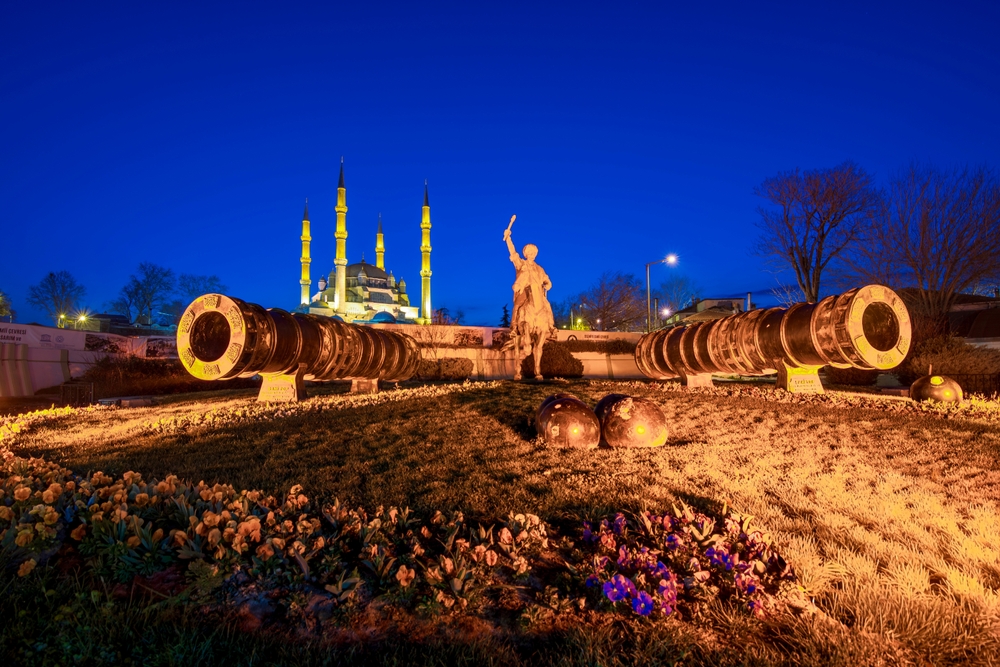
The Minarets: The four minarets, each standing 83 meters (272 feet) tall, were not merely decorative. They served as visual anchors that balanced the massive dome and gave the entire composition its characteristic silhouette. Each minaret contains three separate staircases — a remarkable engineering feat that allowed three muezzins to ascend simultaneously without meeting.
The Windows: Sinan pierced the walls and dome drum with 999 windows of varying sizes. This was not just aesthetic; the windows were structurally calculated to reduce the dead weight of the walls while flooding the interior with natural light.
Construction Workforce
Historical records suggest that hundreds of skilled craftsmen worked on the mosque, including:
- Stone masons from across the empire
- Iznik tile makers producing the finest ceramic panels of the era
- Calligraphers who inscribed Quranic verses throughout the interior
- Carpenters who created the intricate woodwork of the mihrab, minbar, and sultan's loge
- Lead workers who covered the dome and semi-domes
The construction cost was enormous by the standards of the time, funded directly from the imperial treasury and supplemented by revenues from conquered territories.
Architectural Innovation
The Octagonal Support System
Sinan's most revolutionary innovation at Selimiye was the octagonal drum system. Rather than using the traditional four-pier system (as at Hagia Sophia) or the cascading half-dome system (as at the Blue Mosque), Sinan placed eight slender pillars in an octagonal arrangement. These pillars support arches and squinches that transition seamlessly to the circular dome drum.
The result was a prayer hall of unprecedented openness. Worshippers anywhere in the mosque have an unobstructed view of the mihrab and minbar — a theological ideal that previous architects had struggled to achieve in large-scale mosques.
Light as a Design Element
Sinan understood that a mosque's spiritual atmosphere depends largely on the quality of its light. At Selimiye, he orchestrated the 999 windows to create a specific light effect: the lower windows produce warm, diffused light near ground level, while the upper windows in the dome drum create an ethereal glow that seems to detach the dome from the building below.
The effect was enhanced by the original stained glass windows (most of which have been replaced over the centuries) and by the mosque's orientation, which catches morning light from the east and afternoon light from the west.
The Inverted Tulip
Beneath the apex of the dome, a small circle of Iznik tiles depicts an inverted tulip — one of the most mysterious and discussed elements of the mosque. Some scholars interpret it as a symbol of humility (the tulip, a symbol of Ottoman power, turned upside down before God). Others suggest it marks the geometric center of the dome or served as a reference point during construction.
From Ottoman Era to Republic
Centuries of Worship
For nearly 350 years after its completion, Selimiye Mosque served as the principal mosque of Edirne and a symbol of Ottoman imperial power. It survived earthquakes, wars, and the gradual decline of the Ottoman Empire.
The Balkan Wars (1912–1913)
Edirne suffered severely during the Balkan Wars. The city was besieged and captured by Bulgarian forces in March 1913. During the siege, the mosque sustained some damage from artillery fire, though the main structure survived largely intact.
The Turkish Republic
After the establishment of the Turkish Republic in 1923, Selimiye Mosque continued to function as an active mosque. It was recognized as one of Turkey's most important historical monuments and placed under state protection.
Restoration History
Selimiye has undergone several major restoration campaigns:
- 1930s–1940s: Early Republican-era repairs focused on structural stability and basic maintenance.
- 1960s: More systematic restoration of the exterior stonework and dome.
- 1980s–1990s: Major interior restoration including cleaning and conservation of Iznik tilework and calligraphy.
- 2006–2011: Comprehensive restoration coinciding with the UNESCO nomination process. This included structural reinforcement, stone cleaning, waterproofing, and restoration of the surrounding kulliye buildings.
- 2019–2022: The most recent major restoration, which involved the dome interior, minarets, and the courtyard fountain.
UNESCO World Heritage Inscription (2011)
In 2011, the Selimiye Mosque and its social complex were inscribed on the UNESCO World Heritage List. The nomination was based on criteria (i) and (iv):
Criterion (i): The Selimiye Mosque represents a masterpiece of human creative genius, being the most harmonious expression of the Ottoman kulliye — a complex of buildings centered around a mosque.
Criterion (iv): The Selimiye Mosque and its Complex is an outstanding example of an Ottoman imperial mosque complex (kulliye) that illustrates the highest point of Ottoman architecture.
The UNESCO committee specifically noted that Sinan's innovation in creating "a large, unitary interior space crowned by a huge floating dome" represented "the most perfect synthesis of his time."
Legacy
Selimiye Mosque's influence extends far beyond Edirne. It represents:
- The pinnacle of Ottoman architecture: No subsequent mosque has surpassed its harmonious proportions and structural elegance.
- Engineering innovation: Sinan's octagonal support system influenced architects for centuries.
- A bridge between civilizations: By surpassing Hagia Sophia's dome, Sinan created a dialogue between Byzantine and Ottoman architectural traditions that continues to inspire scholars.
- A symbol of Edirne: The mosque defines the city's identity and is its most recognizable landmark.
Today, Selimiye stands not only as a functioning mosque and place of pilgrimage, but as a testament to the creative ambition of one man who spent his entire career perfecting the art of building.